Building a European community beyond borders: Why a sense of belonging matters
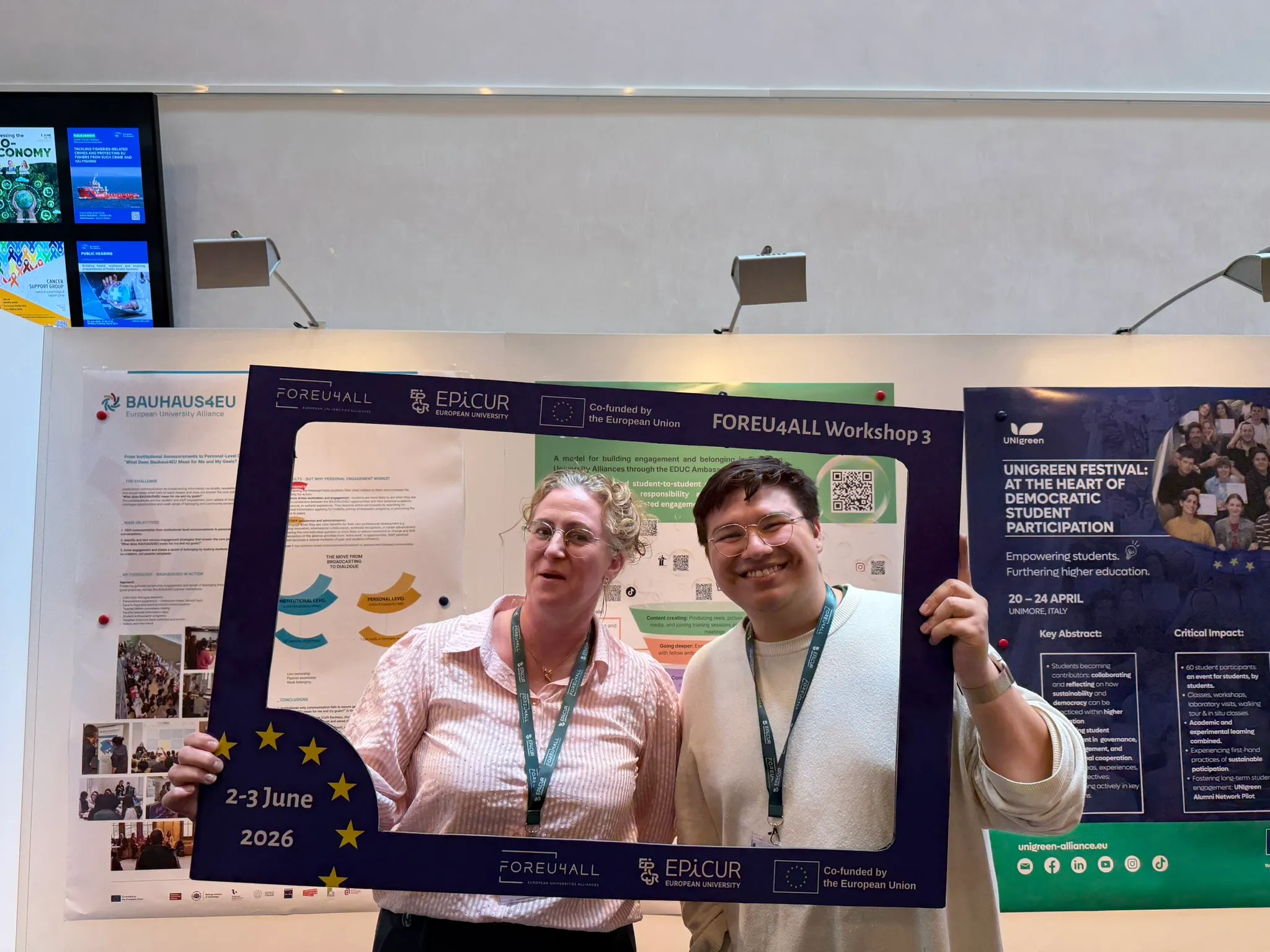
A Coffee4ALL initiative, workshops for university rectors and FestivAlliance were among the twelve prototype solutions developed during last week’s ForEU4All conference in Strasbourg. University of Twente staff member Sandra Pool and Hamburg University of Technology student Eddie Arriaga Flores attended on behalf of ECIU University.
The two-day conference brought together 138 representatives from 58 European University Alliances. Hosted at the European Parliament, the event focused on a key question: how can European alliances create a stronger sense of belonging among students, staff and academics across national borders? The ideas generated will be presented to university rectors in Brussels this week, where they are expected to contribute to discussion on the future of European University Alliances.
Addressing uncertainties
These forthcoming discussions were already enriched by contributions from stakeholders, who offered their perspectives on the evolving role and potential of the alliances. One of the most significant contributions came through a video message from Madame Laurence Farreng, Member of the European Parliament. Farreng acknowledged that alliances have already achieved much more than traditional partnerships.
‘They have created a genuine sense of belonging among students, academics, and professional staff across Europe.’
However, she also stressed that more work remains to be done. In particular, she argued that too many students and teachers are still insufficiently aware of the opportunities and benefits created by the alliances.
And this brings her to the important questions regarding the future sustainability of the alliances within the Erasmus framework for the 2028–2034 programming period. She highlighted concerns about the lack of clarity surrounding future funding mechanisms and the absence of a dedicated budget structure. Addressing these uncertainties will be essential if alliances are to continue expanding their activities in the area of belonging and engagement, and to deliver long-term impact.
Deepen European cooperation further
Creating a genuine sense of belonging requires more than mobility programmes, institutional agreements and collaborative projects, said Giovanni Andriolo (ForEU4All Community Engagement Topical Group, International officer at University of Turin, UNITA Alliance) at the opening session.
‘This is not just another workshop and not just another project,’ he said. ‘Strong alliances can only succeed when they are supported by the entire community. Everyone needs to be on board.’
Birte Wassenberg (Vice-President for Europe and International Relations at the University of Strasbourg and representative of the EPICUR Alliance) placed the discussion within a broader European context. While programmes such as Erasmus have connected generations of students through international mobility, she argued that university alliances have the potential to deepen European cooperation even further.
‘Creating a sense of Europe is not only about exchange. It is about connection,’ Wassenberg said. ‘Community-building is a long-term effort. University alliances could be vehicles for strengthening European values, democratic participation and institutional cooperation.’
Shared goals and feeling seen
The opening session was followed by a keynote panel centered on the question: why does a sense of belonging matter? For Danielle Taylor (Associate Professor at Université Paris 1 Panthéon-Sorbonne), the answer begins with defining the type of community alliances want to create.
‘What kind of community do we want to be’, she wondered. ‘Belonging means having shared goals and feeling seen within that community.’
Francesco Girotti (Head of the Una Europa Unit at the University of Bologna), shared insights from his research into how universities are adapting to increasing internationalisation. ‘To create engagement, implementation units need to be connected directly to university leadership and work across departments rather than in silos,’ Girotti said.
Student participation emerged as another recurring theme. Eddie Arriaga Flores (co-chair of the ForEU4All Topical Group Student-led Community on Sustainable and Democratic Student Participation), stressed that belonging cannot be taken for granted in multinational and multilingual environments.
‘In European alliances, we do not always share the same language or context, so we need to find consensus about what kind of community we want to become.’
Audience members echoed many of these concerns. Results from a Mentimeter poll involving all participants revealed a perceived gap between the ambitions of European University Alliances and the everyday experience of belonging among students and staff. Limited budgets, varying levels of institutional commitment and difficulties in measuring impact were identified as key challenges.
However, according to an awareness survey conducted at the end of 2025, ECIU University has an awareness rate of 49% among students and staff of ECIU partner institutions.
Festival toolkit
At the same time, the workshops generated a wide range of creative solutions. Among the twelve prototypes developed was FestivAlliance, to which Sandra Pool contributed.
‘The assignment was to raise awareness of alliances among students and staff. Our idea is to develop a festival toolkit that alliances and their partners can use to organise a festival event at local level.’
The model is built around the universal language’s sports, art, music, film, and food.
‘It offers a range of activities with varying levels of complexity. This allows each partner university to decide which activities to implement based on its available budget, resources, and time.’
This is one of the twelve ideas submitted which all reflected a shared belief that engagement grows when people have opportunities to meet, collaborate and build relationships.
The closing session highlighted the importance of timing, as discussions on the future funding of European University Alliances are currently taking place. Speakers stressed that alliances must clearly demonstrate their impact and the value they create for students, staff, institutions and society.
Timing
Alison Garnier-Rivers (Alliance Manager of the EPICUR Alliance at the University of Strasbourg) noted that alliances are increasingly evolving into strategic partnerships.
‘With approximately 150 university rectors meeting in Brussels next week, the outcomes of this conference will help inform discussions with the European Commission and other stakeholders,’ she said.
As the prototypes and recommendations move forward to Brussels, the message from Strasbourg is clear: the future success of European University Alliances will depend not only on structures, funding and policies, but also on fostering a strong sense of belonging.
Author: Sandra Pool
Source: University of Twente


ECIU
The European Consortium of Innovative Universities is a network of universities who are united by a common profile, by shared beliefs and interests and mutual trust.All ECIU universities have strengths in engineering and social sciences.

1.webp)