ECIU University in the making: How we help students certify their skills through micro-credentials
What happens after a learner signs up for the course and completes it successfully? At ECIU University, they can certify their achievements, store and share them online and build a stronger CV that allows them to stand out in the job market and explore even more opportunities.
All of it is possible thanks to micro-credentials – digital, certified and tamper-proof records of students’ accomplishments, which are among the responsibilities of Work Package 4. WP4 has integrated micro-credentials into the alliance’s ecosystem and now works even harder to support this framework and enable lifelong learning across borders.
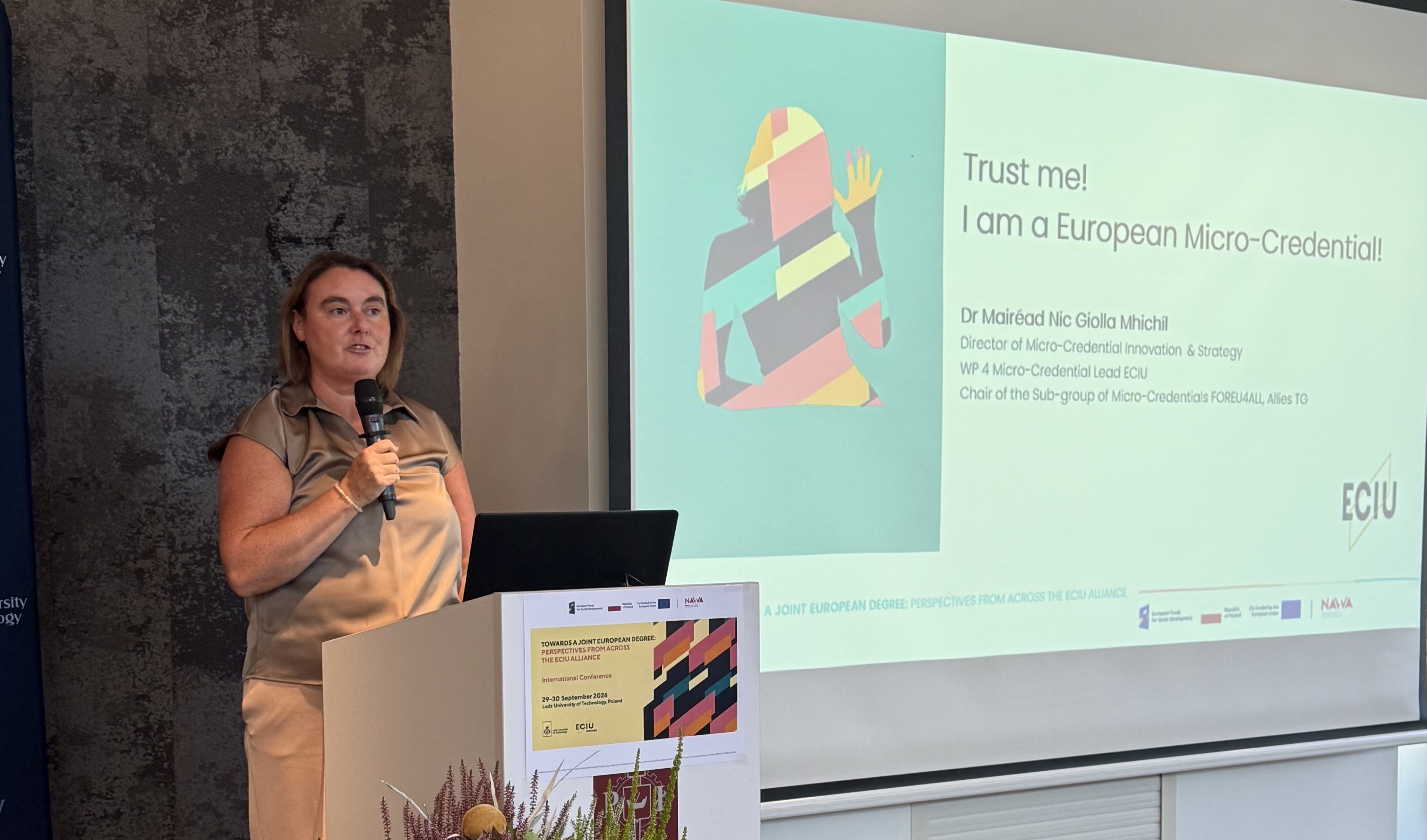
We met with Dr Mairéad Nic Giolla Mhichíl, Micro-Credential Lead at ECIU University and Director of Micro-Credential Strategy and Innovation at Dublin City University, to discuss the journey behind micro-credentials, WP4’s effect on the student experience at ECIU University, and how it’s looking to change the European educational landscape.
Question: How would you describe the main goal and tasks of Work Package 4?
Dr Mairéad Nic Giolla Mhichíl: WP4 drives ECIU University's European approach to micro-credentials by developing and informing the policies, frameworks, and digital solutions needed to make flexible learning pathways visible, trusted, and transferable across borders. Through its work, learners can gain recognised evidence of their skills and achievements, supporting lifelong learning and creating new opportunities for education and employment across Europe.
WP4 also works closely with partners and policymakers at national and European levels to ensure that ECIU University's micro-credential ecosystem responds to real societal and labour market needs while aligned with European policy developments. Together, we’ve helped shape and implement practical frameworks for issuing, recognising, and sharing micro-credentials across institutions and borders.
Q: Could you also explain in more detail what micro-credentials are – and what makes them so special?
Mairead: Micro-credentials are certified records of learning that recognise knowledge, skills, and competences acquired through ECIU University learning experiences. They provide learners with evidence of achievements in a specific area and support lifelong learning, upskilling, and reskilling opportunities. They are also closely linked to challenge-based learning, where learners work on real societal and industry challenges in collaboration with external stakeholders.
WP4 has led the development of the frameworks, policies, and technical infrastructure needed to integrate micro-credentials across the ECIU University ecosystem. This means that learners can participate in learning opportunities offered by different universities within the alliance and receive credentials issued under a shared set of principles and quality standards.
The result is a more flexible and personalised learning experience that allows learners to securely store, share, and prove their achievements across institutions, sectors, and national borders.
Q: When it comes to micro-credentials, ECIU University is among the forerunners. What makes its approach unique?
Mairead: ECIU University is among the pioneers in translating European policy into practice through micro-credentials. What makes its approach stand out is that we combine educational innovation, European collaboration, and trusted digital credential technology into one ecosystem. We are creating a model where learning achieved through real-world challenges can be recognised, verified, and valued across institutions, employers, and countries – throughout Europe and globally.
By aligning our micro-credential model with emerging European standards and creating a scalable technical solution, the alliance has demonstrated how the European vision for flexible, learner-centred education can become a reality. This work is a blueprint for the future of credentials in European higher education and lifelong learning.
Q: Overall, what impact have WP4 and its work with micro-credentials and flexible learning pathways had on ECIU University and its community, in your opinion?
Mairead: WP4 has helped create a more connected, learner-centred ECIU University by introducing shared policies, common quality standards, and verifiable digital credentials across the alliance. This has made learning achievements more transparent, portable, and easier to recognise across institutions and borders.
For learners, this means greater flexibility to build personalised learning pathways and gain trusted recognition for skills developed through challenge-based learning. For the wider community, WP4 has strengthened collaboration between universities, employers, and policymakers. It also positioned ECIU University as a European leader in micro-credential innovation and implementation, breaking down barriers for lifelong and flexible learning.

Q: With so much already achieved, what are WP4’s plans for the future?
Mairead: For now, our focus is on enhancing the ECIU University learning and credentialing ecosystem, strengthening recognition and quality assurance frameworks, expanding the adoption of verifiable digital credentials, and contributing to European policy developments through our leadership role in the FOREU4ALL community of practice. Through this work, we aim to help build a more connected European skills ecosystem where learning can be recognised, trusted, and valued across institutions, sectors, and borders.
Meanwhile, the next phase will prioritise scaling our micro-credential system and improving the digital credential infrastructure. This includes not only enhancing processes but also supporting a broader range of learners, such as lifelong and career-focused learners.
Looking ahead, I hope WP4 continues to play a leading role in shaping the European micro-credential landscape, including developing a European Micro-Credential Label. Our ambition is to help create a trusted, scalable, and sustainable European skills ecosystem where learning can be recognised, verified, and valued across borders.
Q: On a more personal note, what does being part of WP4 and ECIU University mean to you – in both personal and professional senses?
Mairead: Professionally, it has allowed me to contribute to the development of policies, frameworks, and digital solutions that move beyond institutional boundaries and support a more flexible, learner-centred approach to education. The work on micro-credentials, quality assurance, and verifiable digital credentials is not simply about new tools or processes; it is about creating the foundations for a more connected and responsive European learning ecosystem.
What motivates me most is the belief that we are helping to build a more inclusive, transparent, and future-oriented European education and learning system. If Europe is to remain competitive and support citizens throughout their learning and working lives, we need flexible and trusted ways to recognise learning. Contributing to that vision through WP4 and ECIU University has been both a privilege and a responsibility.
On a personal level, being part of a community of colleagues across Europe who share a commitment to innovation and collaboration has been incredibly inspiring. ECIU University demonstrates what is possible when institutions work together to address common challenges – and create meaningful opportunities for learners.
ECIU University's role in shaping the future of flexible learning and micro-credentials is reflected in the newest policy papers, to which WP4 has contributed. The first one, Towards a European Skills Ecosystem 2026, explores how micro-credentials can be more effectively integrated into National Qualifications Frameworks (NQFs) across Europe. The second, ECIU University paper on the ESG 2026, focuses on revising the European Standards and Guidelines for Quality Assurance (ESG).
Together, the papers demonstrate how WP4 is not only implementing micro-credentials in practice but also helping to shape the European policy environment that will support their long-term recognition, quality assurance, and adoption across the European Higher Education Area.
Interview by: Anastasiya Bukhtiarova

ECIU
The European Consortium of Innovative Universities is a network of universities who are united by a common profile, by shared beliefs and interests and mutual trust.All ECIU universities have strengths in engineering and social sciences.