Challenge Based Learning and Future Skills Through ECIU University
.webp)
Challenge-Based Learning (CBL) is gaining ground throughout European higher education institutions, as they look for ways to better equip learners with the skills needed for the twenty-first century workplace. CBL serves as a connector between education and societal challenges, enabling students to develop transversal and future-oriented skills while working cross-disciplinarily, across institutions and national borders.
This was at the centre of the ECIU University webinar on Challenge-Based Learning, held on 11 September 2026. With more than 200 participants, the webinar brought together policymakers, universities, European Universities alliances, students and societal stakeholders to discuss how CBL can contribute to the future of higher education in Europe.
Timothy James Marshall, User Experience Strategy for Learning Innovation and Challenge-Based Learning Researcher, ECIU University presented the new ECIU University paper Challenge Based Learning and Future Skills Through ECIU University. The paper connects CBL to EU priorities such as the Union of Skills, European competitiveness and the European Research Area, while drawing on ECIU University's experience of implementing the approach since 2019.
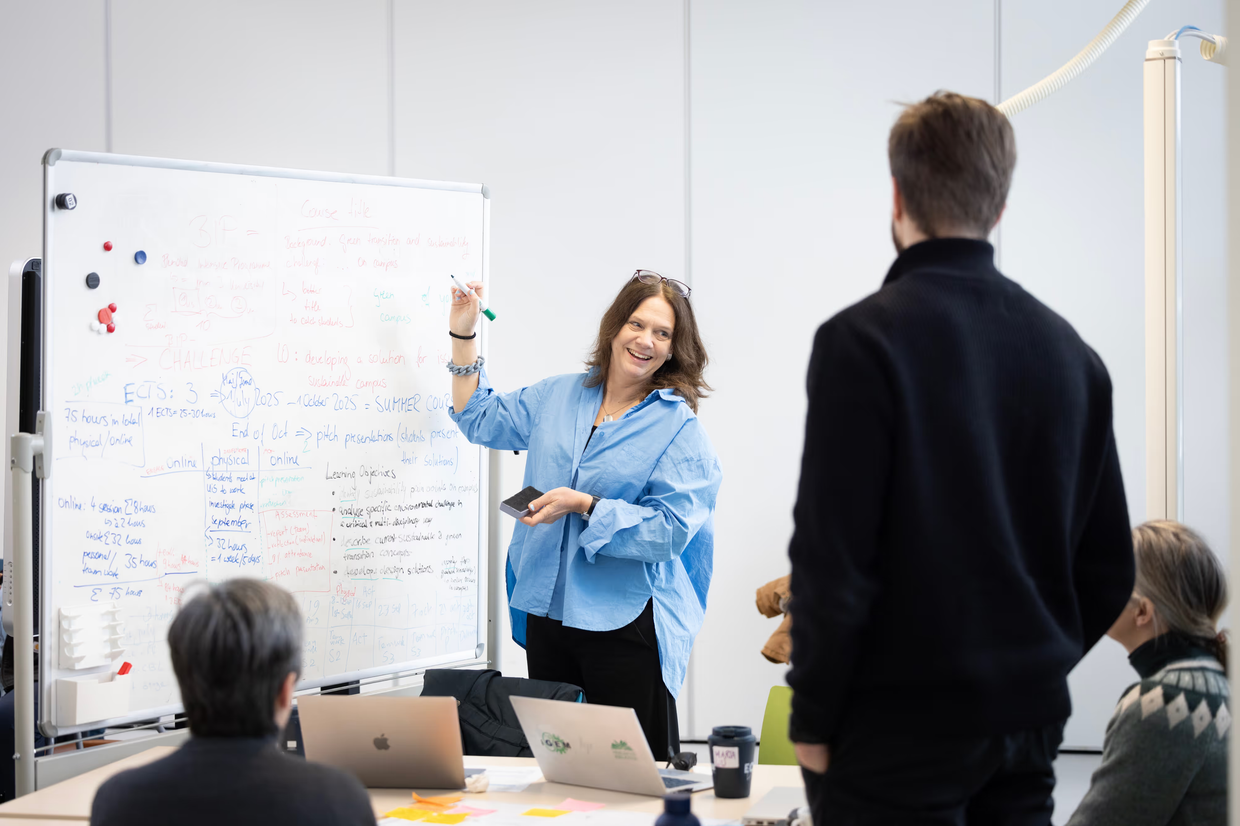
CBL takes learning beyond traditional methods by engaging learners with real-world challenges. Students work collaboratively in multidisciplinary settings, investigate problems and develop possible solutions, while educators take on a more facilitative role. Within ECIU University, this process is structured around three phases: Engage, Investigate and Act.
Students develop skills such as critical thinking, communication, teamwork, creativity and problem-solving while engaging directly with societal stakeholders, bridging the gap between the classroom and the workplace. Since 2019, ECIU University has provided more than 700 learning opportunities to more than 10,000 participants, including over 200 societal challenges addressed together with non-academic partners.
Opening the webinar, Susanne Conze, Head of the Higher Education Unit at the European Commission, placed CBL within the wider ongoing transformation of education. She underlined that learning through challenges changes not only what students learn, but also in what ways that learning happens, how learning outcomes are assessed and what is expected from both the learners and the educators.
The webinar also explored what is needed to embed CBL more sustainably. Research presented by Claire Gormley, from Dublin City University, highlighted the importance of dedicating time and resources to interdisciplinary course design, recognising staff engagement in CBL within workload and career progression models, and providing professional development for teaching staff. These priorities are also reflected in the recommendations of the ECIU paper.
Experiences from other university alliances (CHARM-EU, EU-CONEXUS, EuroTeQ and EUGLOH) demonstrated the diversity of CBL approaches already being developed across alliances. From joint master's programmes and Blended Intensive Programmes (BIPs) to Living Labs and entrepreneurship pathways, CBL is being applied across different formats and disciplines.
The student perspective brought these principles into practice. During the webinar, Oksana Paslavska, from the University of Trento, described how a Brexit negotiation game transformed a short learning experience into an opportunity to apply knowledge while developing communication, teamwork and critical thinking. João Santos, from the University of Aveiro, reflected on how repeated participation in challenges across ECIU University encouraged him to work beyond his own discipline and changed the way he approaches problems.
The discussion during the webinar came to ultimately the same conclusion as the paper - that CBL is not only a teaching methodology, but a way of connecting education, research, innovation and service to society around real-world challenges.
For universities, alliances and policymakers, the next step is, therefore, to create the conditions that allow CBL to move from individual initiatives towards more sustainable and scalable implementation, through flexible study programmes, recognition of micro-credentials, short-term mobility opportunities, interoperability of systems, increased staff development and stronger collaboration with societal stakeholders.
Missed the webinar? You can watch the recording here:

ECIU
The European Consortium of Innovative Universities is a network of universities who are united by a common profile, by shared beliefs and interests and mutual trust.All ECIU universities have strengths in engineering and social sciences.