ECIU calls for strong education and training share in next Erasmus+ programme

The European Parliament's Committee on Culture and Education (CULT) has published its draft report introducing amendments to the European Commission’s proposal for the 2028-2034 Erasmus+ programme.
Following the joint amendments proposed by the higher education sector in February of this year, the signatories of this statement, representing Europe's universities and higher education institutions, student organisations and stakeholders, welcome MEP Bogdan Zdrojewski’s central message:
Erasmus+ must remain, first and foremost, Europe’s flagship programme for education and training, learning mobility and transnational cooperation, with a budget that fully reflects the level of ambition, expectations and objectives that this entails.
- The draft report’s call for €47.39 billion for Erasmus+ under the EU’s next long-term budget (multiannual financial framework) is a welcome step in the right direction, compared to the European Commission’s proposal.
- The draft report also reflects the sector’s call for the introduction of minimum budget allocations for the different sectors and actions of the programme. This fosters transparency and enables planning security for beneficiaries, national agencies, to sustain quality and access throughout the programming period.
- In addition, the draft report proposes substantial synergies with other Union programmes and funding sources such as the proposed co-funding of the new scholarships in strategic educational fields by the European Competitiveness Fund, as well as for the European Universities Alliances.
All of these developments are a positive step towards the new programme. However, the suggested budget would still only just allow the programme to maintain its current level of activities. It would not be sufficient to support the programme’s expanded scope, new actions and growing expectations.
In addition to this, the report proposes a budget share of 73,4% for education and training, a de facto reduction of up to 10 percentage points compared to the current share for the sector. A lower budget, or a weaker share for education and training, would inevitably limit opportunities across the entire programme, reduce access to mobility and undermine the mobility targets set by the member states.
The higher education sector therefore urges the European Parliament to readjust the proposed budget share for education and training to its level under the current programme, recognising its importance at the core of Erasmus+, the European Education Area and the Union of Skills, as well as the EU’s competitiveness agenda.
Erasmus+ changes lives, strengthens education and builds the next generation of Europeans. The next programme must be equipped with the budget, governance, funding lines and predictability needed to continue delivering for learners, staff, institutions and society, while reinforcing international collaboration and systematically enhancing its accessibility to all.
Provided that these issues are addressed, the European Parliament’s position will be instrumental in making the next Erasmus+ programme a success.
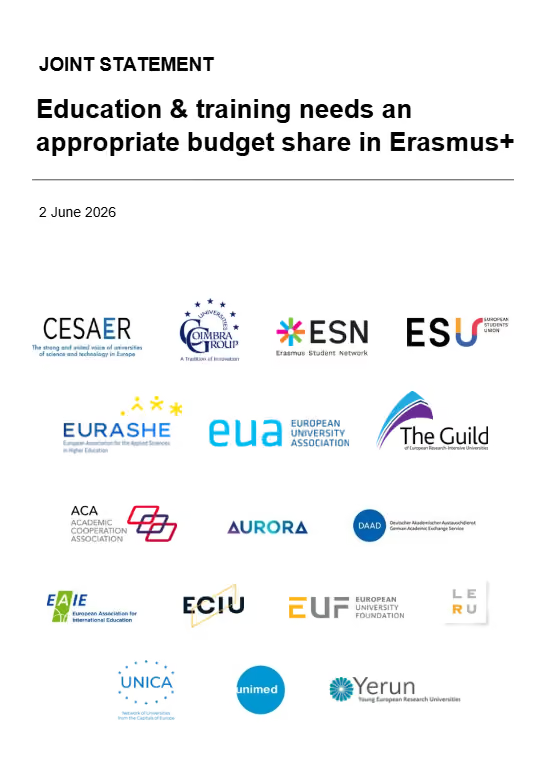
SIGNATORIES
ACA - https://aca-secretariat.be/
AURORA - https://aurora-universities.eu/
CESAER - https://www.cesaer.org/
Coimbra Group - https://www.coimbra-group.eu/
DAAD - https://www.daad.de/en/
EAIE - www.eaie.org
ECIU - https://www.eciu.eu/
ESN - https://www.esn.org/
ESU - https://esu-online.org/
EUA - https://www.eua.eu/
EUF - https://uni-foundation.eu/
EURASHE - https://www.eurashe.eu/
The Guild - https://www.the-guild.eu/
LERU - https://www.leru.org/
UNICA - www.unica-network.eu
UNIMED - https://www.uni-med.net/
YERUN - https://yerun.eu/

ECIU
The European Consortium of Innovative Universities is a network of universities who are united by a common profile, by shared beliefs and interests and mutual trust.All ECIU universities have strengths in engineering and social sciences.

.webp)