European Universities have proven their value. Now their future must be secured.

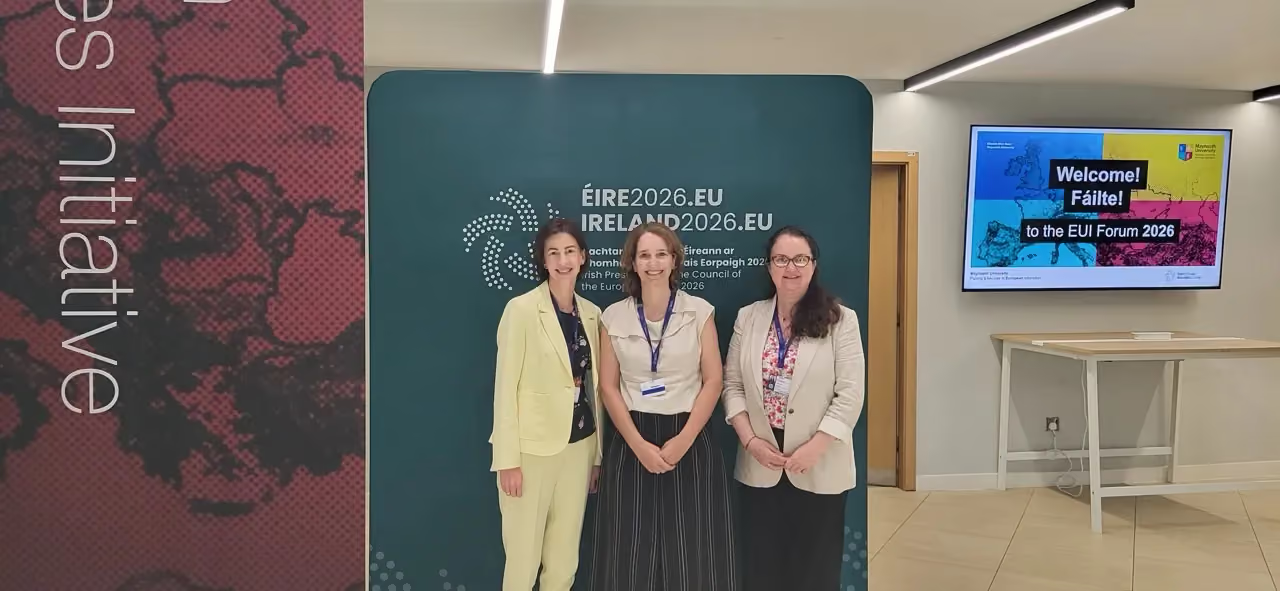
There was a noticeable shift at the 4th European Universities Initiative (EUI) Forum in Maynooth, Ireland.
For several years, European Universities alliances have demonstrated the value of deep transnational cooperation. This year's discussions moved beyond the question of whether alliances work. The message from university leaders, policymakers, students, and stakeholder organisations was remarkably consistent: they do. The real question now is whether Europe is prepared to provide the long-term political, legal, and financial conditions needed for alliances to realise their full potential.
Throughout the Forum, participants shared compelling examples of how European Universities alliances are reshaping higher education. Increasingly, alliances are evolving into integrated ecosystems that connect education, research, innovation, and societal engagement, helping universities contribute to Europe's priorities, from competitiveness and skills development to sustainability and resilience.
For ECIU University, this is already a reality. Through challenge-based learning, flexible learning opportunities, micro-credentials, and close collaboration with societal partners, ECIU University is demonstrating how universities can equip learners and communities to address complex real-world challenges. The Forum reinforced the importance of scaling this impact across Europe.
This perspective was echoed by Sandra Soares, Vice-Rector for Education and Student Affairs at the University of Aveiro and Chair of the ECIU Vice-Presidents for Education Group, who participated in the expert panel discussion "The Power of the Collective: Alliances as Strategic Actors":
"ECIU University shows that when universities collaborate around real-world challenges, innovation becomes part of everyday learning. European University Alliances are creating the conditions for a more flexible, learner-centred and resilient higher education system in Europe."
One message stood above all others: the momentum must not be lost.
Speakers repeatedly stressed that the current project-based funding model is no longer sufficient for alliances that have become strategic, long-term partnerships. Sustainable investment, enabling legal frameworks, and closer alignment between European ambitions and national policies are now essential if the initiative is to move from successful experimentation to lasting structural change.
For ECIU University, the message was clear: meaningful transformation requires innovation to be embedded in the core activities of universities. Turning initiatives such as challenge-based learning, micro-credentials, and societal engagement into lasting practice will require sustained investment, supportive policies, and long-term commitment.
The dialogue will continue at the 5th European Universities Initiative Forum, which will be hosted by ECIU University partner Kaunas University of Technology (KTU) in Kaunas on 17-18 March 2027, during Lithuania's Presidency of the Council of the European Union. Building on the reflections from Maynooth, the Forum will explore how European Universities alliances can further strengthen their role as drivers of an open, competitive, resilient, and democratic Europe. Further information and registration details will be available in autumn 2026.
The train has left the station. Europe now has the opportunity, and the responsibility, to ensure that it reaches its destination.
Article by Andrea Brose, ECIU CSC Education Lead

ECIU
The European Consortium of Innovative Universities is a network of universities who are united by a common profile, by shared beliefs and interests and mutual trust.All ECIU universities have strengths in engineering and social sciences.

.webp)