The ESEU pilot tested a possible European legal status for higher education institutions to simplify international cooperation and advice European policymakers about shaping future policies.
The ESEU pilot tested a possible European legal status for higher education institutions to simplify international cooperation and advice European policymakers about shaping future policies.
ESEU


Project overview
The ESEU policy pilot,in which all ECIU members and many of their national authorities are partners,tested a possible European legal status for higher education institutions tosimplify international cooperation and advice European policymakers aboutshaping future policies in this field. The project reported on the legalimplications, benefits, challenges and feasibility of the European Grouping ofTerritorial Cooperation (EGTC), the European Cooperative Society (SCE), theSocietas Europea (SE) and the European Institute of Innovation and Technology(EIT).
The ESEU-project isrelevant for universities that wish to overcome obstacles to achieve a deep andlong-term cooperation at the European level, e.g. to make common strategicdecisions, experiment joint recruitment and design joint curricula. The projectis also relevant for policy-makers at the national and European level tosupport the improvements of available legal instruments and to deliver on theneeds of European University Alliances. The project has published severalreports that can be found on the project website.
The ESEU-projectwas one of the four Erasmus+ legal policy experimentation projects that testedand implemented institutionalised EU cooperation instruments.
Impact
Events
Activities
- Kick-off meeting
The ESEU-project kicked-off on 13 March with an online event with 50 participants.
Learn more - Needs analysis
Eight use cases are formulated, in the field of education, research, governance, finance and identity, based on the existing needs analysis of ECIU University. The use cases are the basis to analyse legal structures, it will help to identify risks and benefits of different structures versus the needs of university alliances. Learn more - Analysis legal structures
Four legal structures have been analysed against the needs of university alliances for cross-border collaboration: The European Grouping of Territorial Cooperation (EGTC), the Societas Europaea (SE), the European Cooperative Society (SCE) and the European Institute of Innovation and Technology (EIT). Learn more - National context and recommendations
The report analyses the national context in transnational university collaboration, and brings together all the work done in work package 2 (defining the use cases, analysing available legal instruments and the national context). Learn more - Summary on key take-aways from ECIU Board Members
During the workshop with the ECIU University Board (September 2024) and the bilateral talks with Board Members and Institutional Coordinators (November 2023), a possible European Status for ECIU University was discussed. The discussions covered the outcomes of the ESEU-project, obstacles Board Members encountered in transnational collaboration, that need for a European solution to these challenges, the national meetings of board members with their Ministries, and how key topics related to European Universities play a role in these talks. Learn more - Annex to final roadmap: adapting EGTC to needs of HEIs
Learn more
Learn more about activities
Partners
Project results and deliverables
Final ESEU-project event
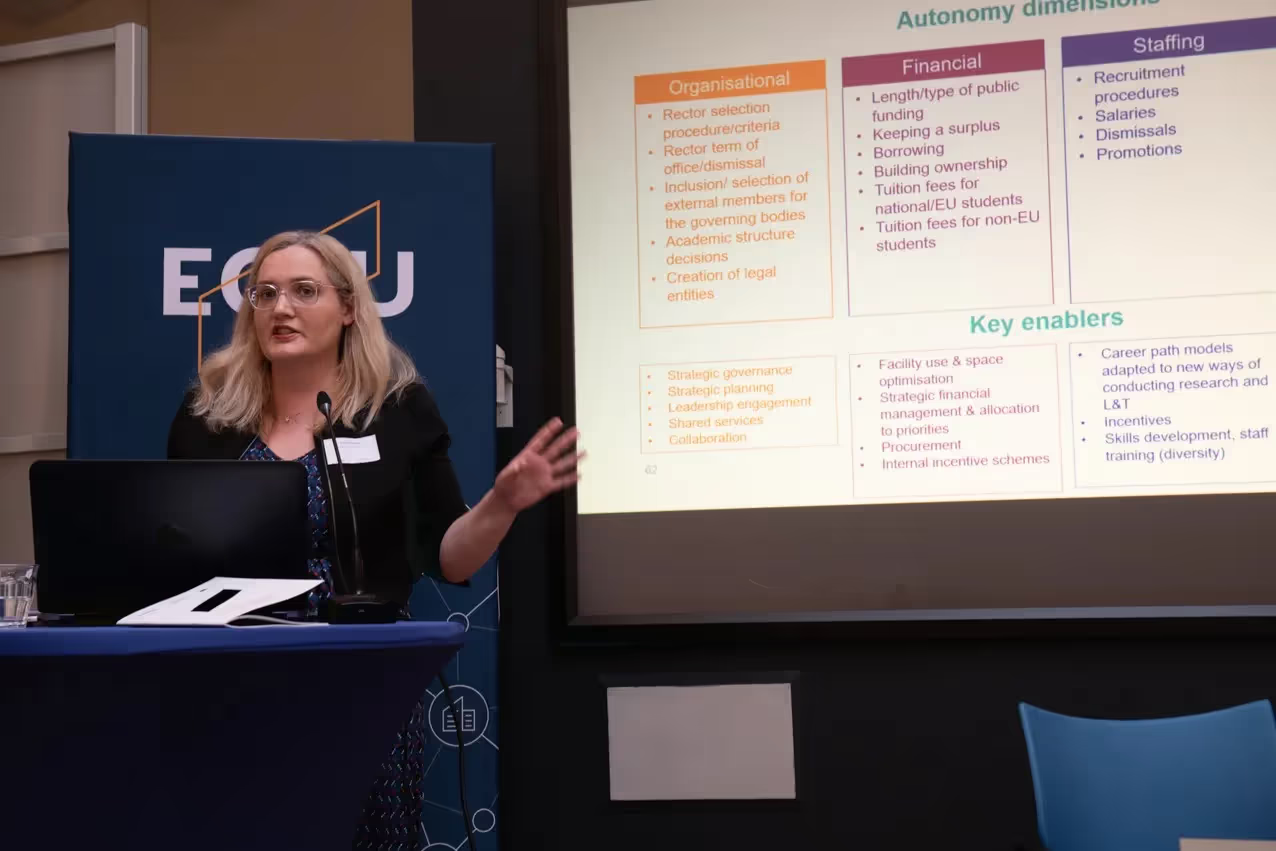
Nearly 200 colleagues from all over Europe gathered online and in Brussels to discuss the way forward for a European legal instrument that serves the needs of higher education institutions.
Learn more
Final report
A roadmap on the next steps for a European legal instrument for transnational higher education cooperation.
The final report brings together all output of the ESEU-project. Context: There is no tailored European legal instrument for higher education institutions to overcome obstacles in transnational cooperation, while there are many expectations for joint activities at the European level. Therefore, a dedicated instrument must be designed. This roadmap formulates next steps for such an instrument.
Learn more